

Wild Mountainous Badakhshan of Tajikistan and the Fertile Fergana Valley of Uzbekistan with Extension Option
- Wild Mountainous Badakhshan of Tajikistan and the Fertile Fergana Valley of Uzbekistan with Extension Option
- Dushanbe-Kalai Khumb-Chorugh-Yamg-Langar-Murghab-Sarytash-Osh-Fergana
- 12 day/12 night
- From Late May to Mid-September
Brief description:
This 12-day (or 19-day with extension) tour explores the wild mountainous Badakhshan region of Tajikistan and the fertile Fergana Valley of Uzbekistan. Starting in Dushanbe with its cultural landmarks like the United Museum and Kokhi Navruz, the journey ventures to Kalai Khumb and Chorog, showcasing Pamir Mountains’ beauty and Buddhist heritage. It continues to Yamg for folklore, Murghab’s high-altitude landscapes, and Ferghana’s silk and pottery crafts. The extension adds Tashkent’s historic sites, Samarkand’s Registan, Bukhara’s architectural gems, and Khiva’s preserved old town, blending adventure with cultural depth.
Day 1: EUROPE – DUSHANBE
Flight the previous day from Europe to Dushanbe via Istanbul. Upon arrival, transfer to the hotel and time to rest. City tour. The United Museum of Tajikistan displays exhibitions on history, natural history, and art; one of the most valuable exhibits is the “Buddha in Nirvana.” Visit to Ismoili Somoni Square and Rudaki Park. Botanical Garden – a beautiful garden with many old trees, a favorite spot for Tajiks. Independence Square.
3 overnight stays at the hotel in Dushanbe.
Day 2: DUSHANBE
Kokhi Navruz – Originally planned as the largest national teahouse in Central Asia, “Kohi Navruz” was transformed during construction into a true museum of Tajik craftsmanship. The entire site, with fountains, summer pavilions, and gardens, spans over four hectares. Around four thousand craftsmen from all regions of Tajikistan were involved in the construction. The craftsmanship of the complex covers approximately 40,000 square meters – including decorative wood carvings on columns and ceilings, wall decorations, Florentine mosaics made of colored mirrors, and painted ceilings. The highest dome is 40 meters tall.
Hissar Fortress – The remains of an 18th-century fortress, used until 1924, are located 30 km west of Dushanbe. Next to the fortress are two simple madrasas, one from the 18th and the other from the 19th century. Behind it lies a mausoleum from the 16th century. Kurushi Kabir Park and Mehrgon market.
Overnight stay at the hotel in Dushanbe.
Day 3: DUSHANBE – KALAI KHUMB
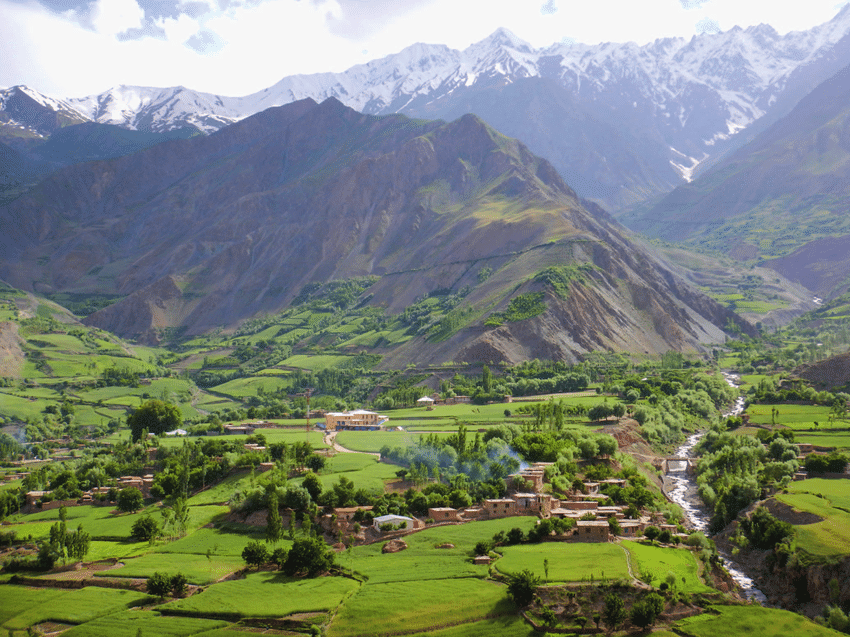
Today, drive to the village of Kalai Khumb. En route, see the Norak Reservoir. The highest point of the day is the Shurabad Pass (2,267 m). Afterward, the journey continues along the Afghan border. This route will impress you with its unique mountain landscape – here begins the Pamir Mountains region.
For centuries, these mountains have inspired famous travelers like Marco Polo and Xuanzang – now you too have the chance to discover this region. The route follows the natural border river Panj. Many travelers call this vast mountain system “the ocean of white and blue mountains.” En route, visit the ancient city of Hulbuk (9th–11th centuries); in the town of Vose, see a museum with finds from the excavation site.
If time permits, visit the women’s center “Mehri Modar” (Mother Love) at the entrance to Kalai Khumb. Here, you can see how Tajik women embroider clothing using traditional and modern techniques. There are beautiful, affordable souvenirs like socks or pillowcases to buy. Otherwise, the center can be visited the next day.
Dinner at the hotel or restaurant in Kalai Khumb.
Overnight stay at the hotel.
Day 4: KALAI KHUMB – CHOROGH IN MOUNTAIN BADAKHSHAN
Drive to Chorog in the High Pamir. The road continues along the Panj River, with views of Afghan villages on the opposite side. It passes through the Vyachsh region – a starting point for trekking tours to the Fedchenko Glacier. The marble deposits in this region are of high quality and clearly visible. From the village of Rushan, the Ismaili section of the route begins. Brief stop at the Vamar Fortress. Near Chorog (10 km), visit the village of Parschinev with the Pir-i Shoh Nosir sanctuary and museum, as well as a holy spring – dedicated to Nosiry Khusrav, the founder of Ismailism in this region (1004). Upon arrival in Chorog, transfer to the hotel.
2 overnight stays at the hotel.
Day 5: CHOROGH
Morning city tour in Chorog. Visit the world’s second-highest botanical garden and the regional museum. Afterward, a walk in the Central Park and a visit to the Tourism Information Center with book and souvenir sales. The population of Badakhshan has a unique culture, reflected in clothing, cuisine, music, architecture, and folklore. After lunch, visit a traditional house, an opportunity to understand the symbolic meaning of its construction. Additionally, see how traditional Pamir hats and wool socks are made.
Overnight stay at the hotel.
Day 6: CHOROGH – YAMG
Drive along the Panj River via Ishkashim to Yamg. En route, visit the famous hot springs of Garam Chashma and the Ali Sanctuary, linked to the legend of the spring’s opening – ideal for a relaxing bath. On the opposite riverbank, see the path Marco Polo likely took to Badakhshan – the area is famous for the legendary ruby mines of La’l-i Badakhshan. Lunch in the village of Ishkashim. Visit the village of Namadgut with the Kah-Kah Fortress from the Kushan period, a local museum (if open), and the Ismaili shrine Oston-i Shobi Mardon (11th century) with unique wood carvings and rock drawings. Arrival in Yamg and transfer to a family house.
Dinner and overnight stay at the house of Aydar Malikmamadov (grandson of Muboraki Vakhoni). Optional: Folklore evening with a children’s dance performance.
The “Eagle Dance,” typical of the Pamirs, is performed in pairs and is widespread in Tajikistan, Afghanistan, Pakistan, and China. The songs address patriotism, daily life, and spirituality – sung in Tajik and local Pamiri dialects.
Overnight stay at the house.
Day 7: YAMG – LYANGAR
Visit the museum of Sufi Muboraki Vakhoni, a local astronomer and poet. His grandson Aydar talks about the solar calendar system and demonstrates the making of traditional instruments, especially the rubab (string instrument). For those interested, see how Pamiri carpets are crafted. Continue to the village of Yamchun, visiting the Bibi Fatima hot springs and the Yamchun Fortress (3rd–1st century BC). After the bath, enjoy breathtaking views of the Pamir Valley. After lunch in Yamg, drive to Lyangar. En route, visit the villages of Zong and Vrang. Evening hike to a gallery of rock inscriptions (300–400 m ascent).
Overnight stay at the house.
Day 8: LYANGAR – MURGHAB
Morning visit to the local shrine Mazor-i Shoh Kambar-i Oftob (“Master of the Sun”). Then drive through the Wakhan region to Murghab. Today, cross several passes: Khargush Pass (4,344 m), Nauzetash Pass (4,314 m), Nayzatosh Pass (3,137 m), Alichur (3,863 m). Stop at the holy spring Ak-Balik (with fish). The landscape is a high alpine semi-desert. In Murghab, visit a handicraft center of the Kyrgyz minority, where local souvenirs can be purchased.
Overnight stay at the Pamir Hotel.
Day 9: MURGHAB – SARY TASCH
Early morning departure toward Kyrgyzstan via three high mountain passes: Akbaital Pass (4,655 m), Uybulok Pass (4,232 m), and Kizil-Art Pass (4,336 m). En route, pass through the semi-desert, see Karakul Lake (3,914 m), and, in clear weather, even the Lenin Peak (7,134 m). After border formalities on the Tajik side, continue to Osh, Kyrgyzstan.
Overnight stay in Osh.
Day 10: OSH – FERGHANA
After a brief city tour, drive to the Kyrgyz-Uzbek border and continue to Ferghana.
2 overnight stays at the hotel in Ferghana.
Day 11: FERGHANA – MARGHILAN – RISHTAN – FERGHANA
Drive to Marghilan and visit a silk workshop. After the bazaar visit, continue to the pottery center in Rishtan. Return to Ferghana.
Overnight stay at the hotel in Ferghana.
Day 12: HOMEWARD JOURNEY
Transfer to the airport and flight via Istanbul to Europe.
EXTENSION
Day 12: FERGHANA – TASHKENT
Train journey to Tashkent. After a turbulent history, Tashkent developed into a renowned craft center in the 16th century. Extensive trade relations brought the city prosperity and prestige. The tour of the Khast Imam Complex with the world’s oldest Quran, and a visit to the Chorsu Bazaar, will prepare you for the days ahead. The itinerary also includes the new town, including Independence Square with the Romanov Palace, Amir Timur Park, and the metro.
Overnight stay at the hotel in Tashkent.
Day 13: TASHKENT – SAMARKAND
Train journey to Samarkand. During the trip, pass large fruit and vegetable plantations. Samarkand is considered one of the oldest cities in the world and was a significant trading hub and capital of the Timurid Empire in the Middle Ages. On the first exploration day, your guide will take you to the Gur Emir Mausoleum, the Shah-i-Zinda necropolis, and the Registan. Samarkand’s historical structures are part of the UNESCO World Heritage.
2 overnight stays at the hotel in Samarkand.
Day 14: SAMARKAND
Today’s program includes visits to: Ulugbek Observatory, the breathtaking Bibi-Khanum Mosque, a paper manufactory, and the Registan Square under night lighting.
Overnight stay at the hotel in Samarkand.
Day 15: SAMARKAND – BUKHARA
Train journey to Bukhara. In this UNESCO city, you’ll enjoy an exciting program: the Ark Citadel, the Bolo Hauz Mosque, the Ismail Samani Mausoleum, and the unusually beautiful Chor Minor gatehouse. The Poi-Kalon Ensemble impresses with the Kalon Minaret, Mir Arab Madrasa, and Kalon Mosque.
2 overnight stays in Bukhara.
Day 16: BUKHARA
Other highlights on your tour include the Magoki-Attori Mosque, the opposing Ulugbek and Abdulaziz Khan Madrasas, and three historical domed bazaars. At the Labi Hauz Complex, the central water basin provides refreshment, with additional monuments concentrated here, such as Nodir Devon Begi and Kukeldash Madrasas.
Overnight stay at the hotel.
Day 17: BUKHARA – KHIVA
Free time until noon. Then the caravan heads to Khiva. Like Mongolian riders of old, you’ll pass oases in the Kizilkum Desert, crossing Central Asia’s largest river. En route, you’ll have the opportunity for a short individual desert hike and to eat fish at a rest stop. Arrive in the oasis city of Khiva by evening.
2 overnight stays at the hotel in Khiva.
Day 18: KHIVA
Another UNESCO city awaits with an intensive tour. You’ll see, among others, the Kunya Ark Citadel, the Pahlavan Mahmud Mausoleum, the Amin Khan Madrasa, the unfinished minaret, the Juma Friday Mosque, the harem courtyard, the Islom Khodja Minaret, and Madrasa.
Overnight stay at the hotel in Khiva.
Day 19: KHIVA – URGENCH – EUROPE
Transfer to Urgench Airport and flight via Istanbul to Europe.
We offer transfers with the following vehicles:
Passenger Cars: Leapmotor, Chevrolet Lacetti, Cobalt, BYD, Skyworth


Minibuses: Toyota Hiace or Hyundai Staria (up to 5–8 seats)

Mid-size Buses: Mitsubishi Rosa or Mercedes Sprinter (up to 15 seats)

Large Buses: Golden Dragon, Yutong, or Higer (up to 45 seats)
